A coin seems to leave plenty of room around it. Once the centers are joined, that room becomes a full turn divided into minimum angles.
A Coin at the Center
Riddle statement
Place a circular coin on a table.
You want to surround it with identical coins, also lying flat on the table, so that:
- every outer coin touches the center coin;
- no two outer coins overlap.
What is the greatest number of coins that can touch the center coin at the same time?
Show solution
Solution
Suppose every coin has radius r.
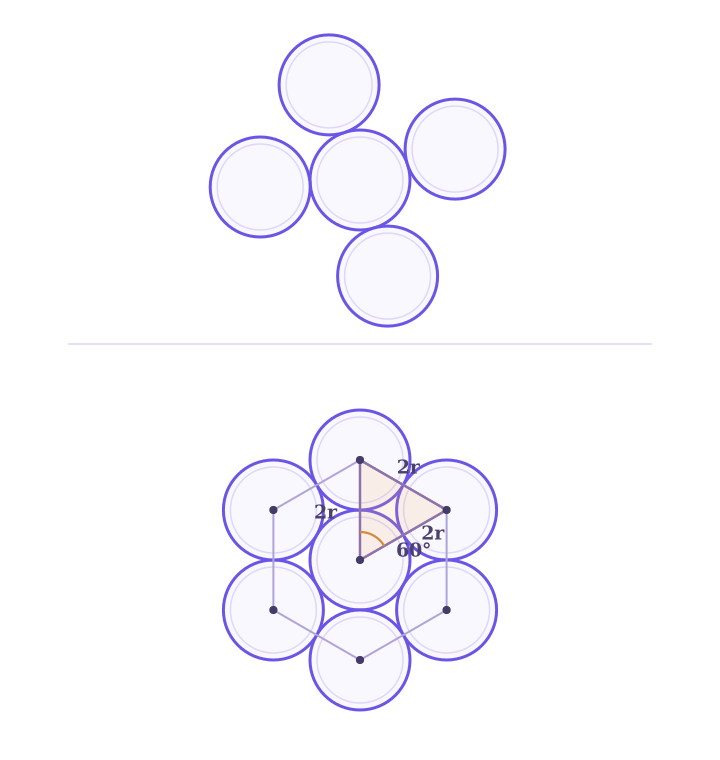
Because every outer coin touches the center coin, its center is 2r from the middle center. All outer centers therefore lie on a circle of radius 2r.
Now consider two consecutive outer coins. Their smallest possible separation without overlap occurs when they also touch each other.
In that limiting position, all three distances between the centers are 2r:
- from the middle center to the first outer center;
- from the middle center to the second outer center;
- between the two outer centers.
The three centers therefore form an equilateral triangle. Each outer coin occupies an angle of at least 60° around the center. If two neighboring outer coins do not touch, their angle is larger.
Since a full turn is 360°, the maximum is:
360° ÷ 60° = 6 coins.
This maximum is achieved by placing the six outer centers at the vertices of a regular hexagon. Each outer coin then touches the center coin and its two neighbors.