Three cords are tied inside a bag without being seen. The outcome feels unpredictable, but there are only fifteen final pairings, and they can be counted exactly.
Six Loose Ends
Riddle statement
Inside an opaque bag are three separate cords. The two ends of each cord stick out, giving six loose ends in total.
Without looking inside, you choose two loose ends at random and tie them together. You repeat the process until no loose ends remain.
The two ends of the same cord are allowed to be tied together. Assume that all final pairings of the six ends are equally likely.
When you remove the cords, you may find:
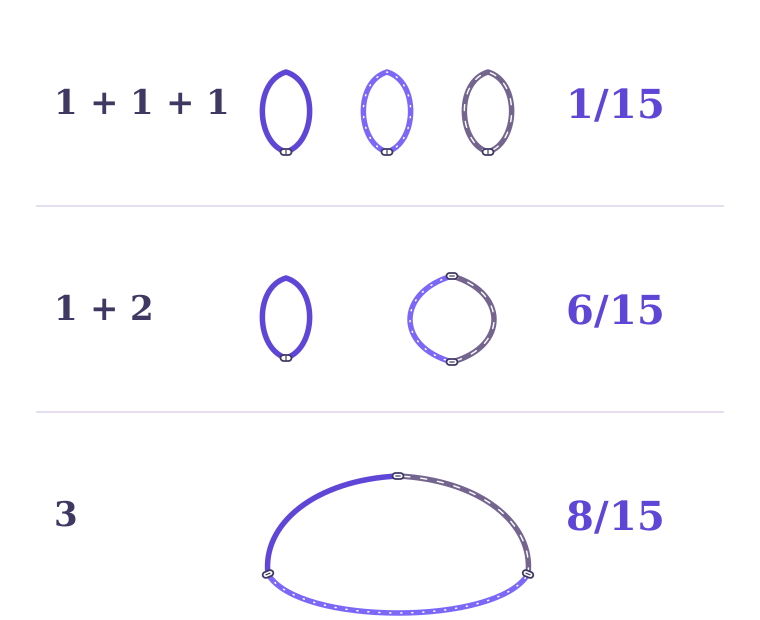
- three separate loops;
- one loop made from a single cord and another made from the remaining two cords;
- one closed necklace made from all three cords.
What is the probability of obtaining a single necklace?
Show solution
Solution
The six ends can be paired in:
5 × 3 × 1 = 15 ways.
All fifteen pairings are equally likely.
1. Three separate loops
Each cord must be tied to itself. There is only 1 pairing of this type.
2. One single-cord loop and one two-cord loop
First choose which of the three cords is tied to itself: there are 3 choices.
The four ends of the other two cords must be joined across the two cords. There are 2 different pairings that produce one loop, even though the two results have the same visible shape.
This second structure therefore occurs in:
3 × 2 = 6 pairings.
The number of pairings that do not form one three-cord necklace is:
1 + 6 = 7.
That leaves:
15 − 7 = 8
pairings that join all three cords into one necklace. Hence:
P = 8/15 ≈ 53.3%.
The probabilities of the three structures are respectively 1/15, 6/15, and 8/15.