An empty table, identical coins and two players. Before any coin is placed, would you rather go first or second?
The First Coin
Riddle statement
Two players take turns placing identical circular coins on a round table. The table is large enough to hold at least one coin. Every coin must lie flat and entirely on the table, without overlapping another coin; edges may touch. Once placed, a coin cannot be moved.
There are as many coins as needed. A player who cannot place a coin on their turn loses.
Can the first player or the second player guarantee a win? Describe a strategy and prove that it always works.
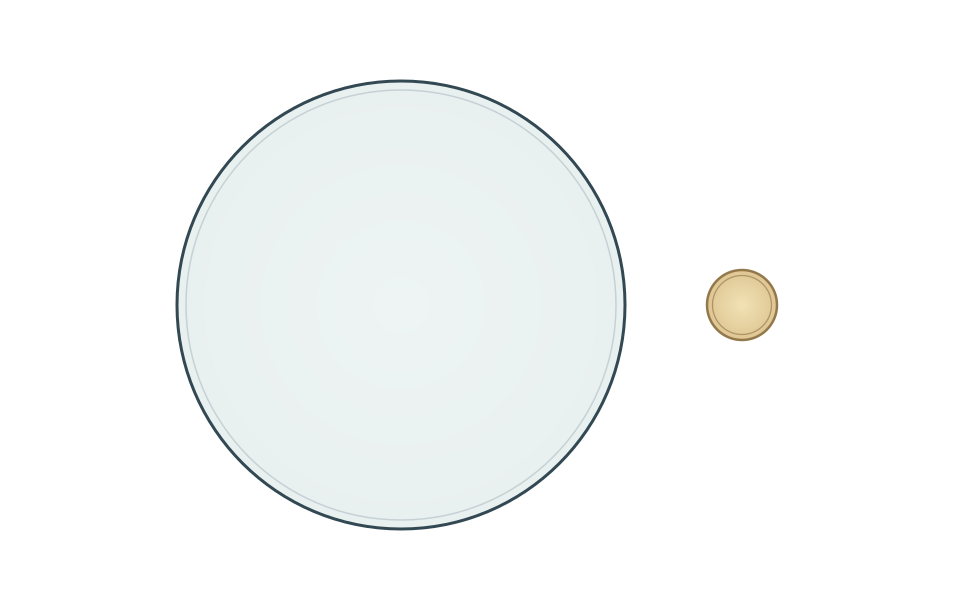
*A circular table and identical coins.*
Show solution
Solution
The first player can guarantee a win. Place the first coin at the exact centre of the table. After each opposing move, place another coin at the position obtained by rotating that move through 180° about the table’s centre.
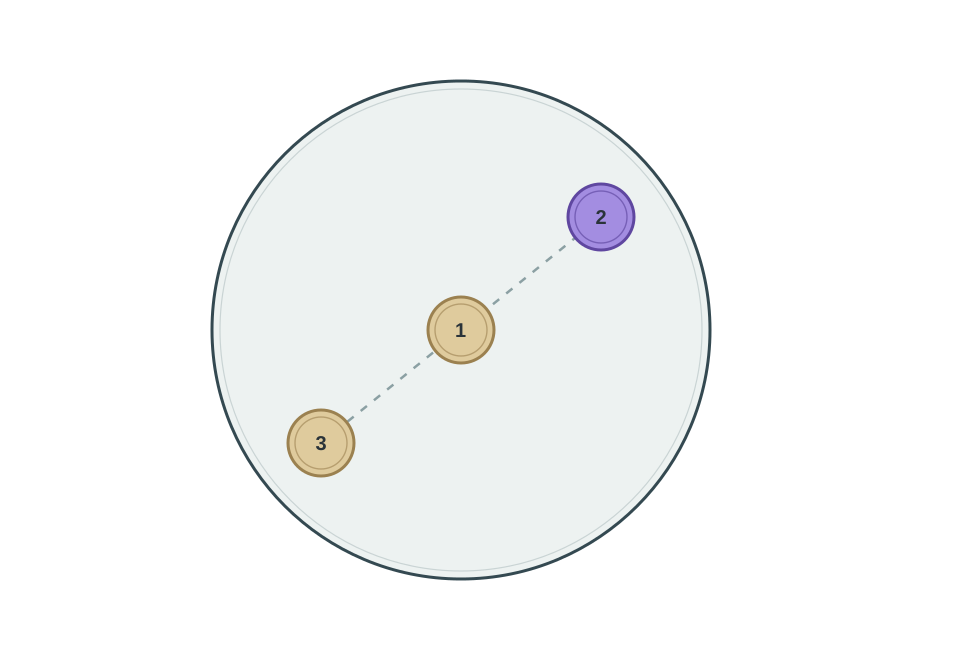
1: first coin, at the center. 2: opponent's move. 3: the first player's symmetric reply.
Why is that reply always legal?
After each of your turns, the whole position is centrally symmetric. If your opponent legally places a coin with centre P, its image with centre −P also lies entirely on the circular table.
Your reply cannot overlap an older coin. If it did, rotating the position would show that the opponent’s new coin overlaps the image of that older coin. That image was already present, contradicting the legality of the opponent’s move.
Your reply also cannot overlap the coin just played. If each coin has radius r, the central coin forces P to be at least 2r from the table’s centre. P and −P are therefore at least 4r apart—more than enough separation.
Finally, the game must end. Each coin has positive area πr², the table has finite area, and coins cannot overlap. So only finitely many coins can be placed.
You always have a legal reply to your opponent. It must therefore be your opponent who runs out of moves first.
The opening coin occupies the only position fixed by the half-turn. Thereafter, the strategy keeps every opposing move paired with an available reply.