No measurement of the original object is available. All you can measure is the height of what remains after drilling.
The Sphere of Unknown Size
Riddle statement
A straight cylindrical hole is drilled right through a sphere, with the axis of the hole passing through the sphere’s centre. All material inside the cylinder is removed.
The remaining solid is 6 centimetres high, measured along the direction of the hole’s axis from its lowest point to its highest. You do not know the radius of the sphere or of the hole.
Can you determine the volume of the remaining solid? If so, calculate it and explain why neither radius is needed.
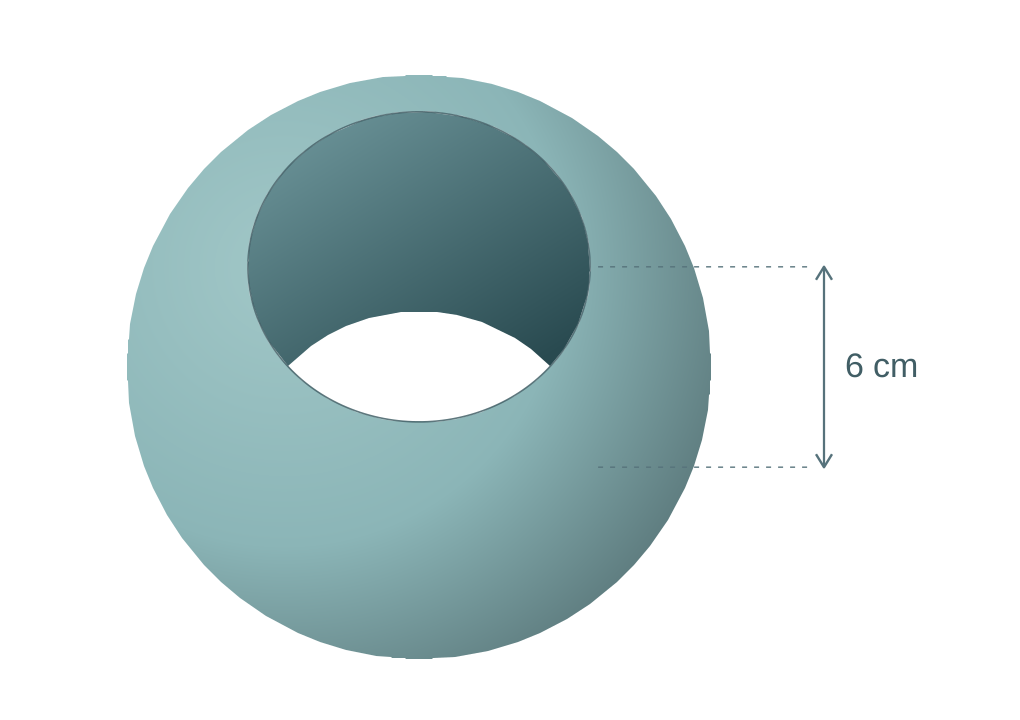
*Three-dimensional view of the remaining solid. The 6 cm height is measured parallel to the hole's axis; the radii are unknown.*
Show solution
Solution
The volume is 36π cm³, regardless of the original sphere’s size.
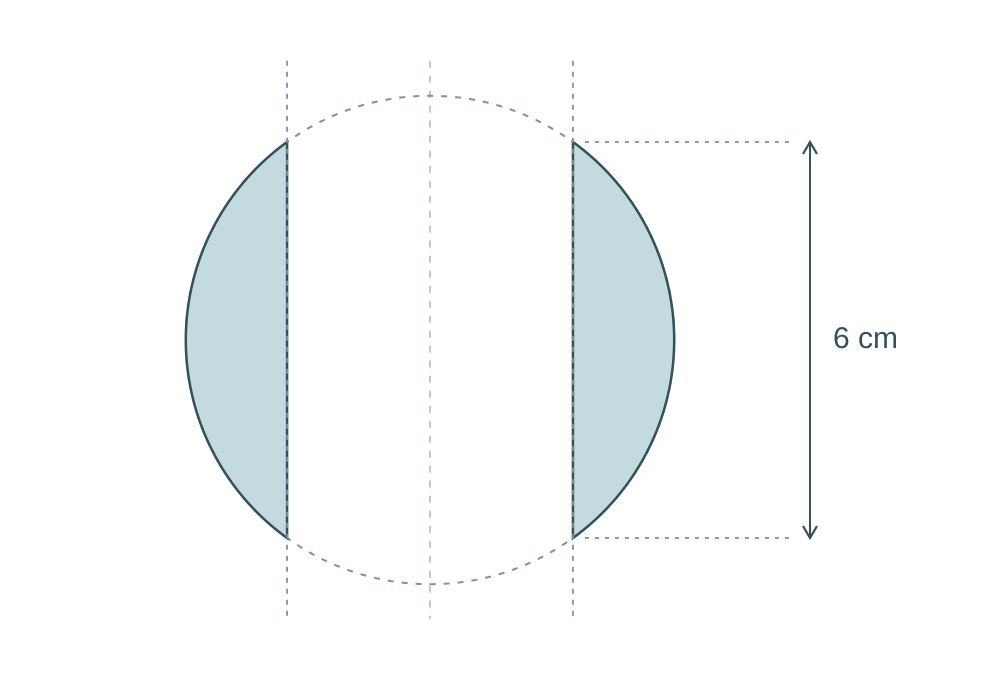
Cross-section through the hole's axis. The dashed line shows the outline of the original sphere.
Let R be the sphere’s radius and r the hole’s radius. Take the centre to be at height z = 0. The remaining solid extends from z = −3 to z = 3. At either end, the sphere’s cross-sectional radius equals r. Pythagoras gives
R² − r² = 3² = 9.
At any height z between −3 and 3, a perpendicular slice is a circular ring. Its outer radius squared is R² − z²; its inner radius is r. Its area is therefore
A(z) = π(R² − z²) − πr² = π(9 − z²).
This is also the area of a slice at height z through a sphere of radius 3 cm.
Cavalieri’s principle says that two solids of equal height have equal volumes if their parallel cross-sections have equal areas at every level. Imagine dividing both into thinner and thinner horizontal layers. Their volumes must agree:
V = (4/3)π × 3³ = 36π cm³.
We are comparing areas, not shapes: the slices of the drilled sphere are rings, while those of the smaller sphere are discs.
A larger sphere requires a wider hole to leave the same height. At every level, the increase in outer area exactly cancels the extra area removed. More generally, a remaining height h gives volume πh³/6.
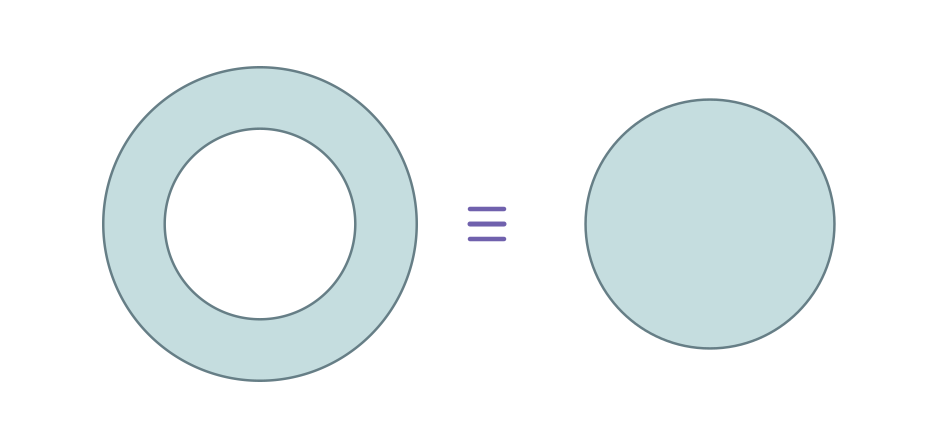
At the same height, the annulus and the disk have exactly the same area, despite their different shapes.