Two random arrivals, a one-hour window, and only fifteen minutes of waiting. The answer is hidden inside a square.
The Fifteen-Minute Meeting
Riddle statement
Two friends agree to meet between 6:00 and 7:00. Each arrives independently of the other, at a time chosen uniformly at random during that hour.
Whoever arrives first waits for 15 minutes. If the other friend does not appear during that time, the first one leaves.
Which is more likely: that they meet or that they miss each other? What is the exact probability that they meet?
Show solution
Solution
Answer: they are more likely to miss each other. The probability that they meet is
Let \(x\) and \(y\) be their arrival times, measured in minutes after 6:00.
Since the two times are chosen independently and uniformly between 0 and 60, every pair \((x,y)\) is an equally likely point inside a square of side 60.
The friends meet if and only if their arrival times differ by no more than 15 minutes:
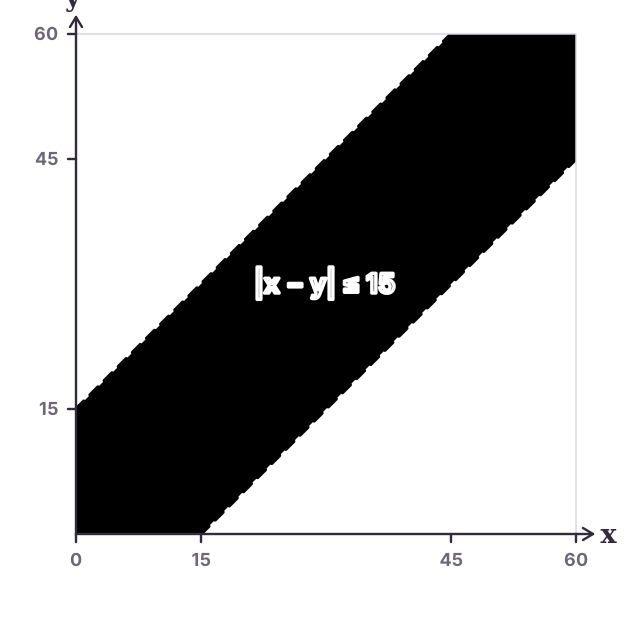
Inside the square, this condition forms a band around the diagonal.
It is simpler to calculate the complementary region. The cases in which they miss each other form two right triangles, each with legs of length
The proportion of the square occupied by those triangles is
Therefore, the probability that they meet is
They meet in only 43.75% of the cases, so missing each other is more likely.