The same rectangular sheet can be turned into two very different cylinders. The amount of material does not change, but that does not mean their capacities must be equal.
Two Cylinders, One Sheet
Riddle statement
You have a very thin rectangular sheet measuring 20 cm by 10 cm.
You can roll it in two ways to form the curved wall of a cylinder:
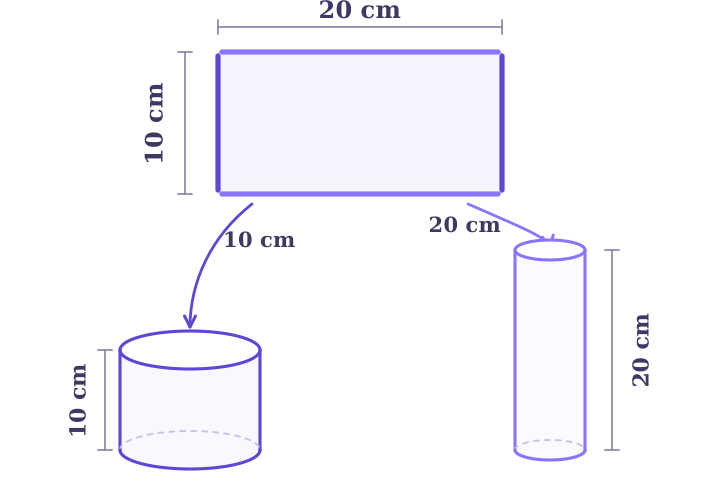
- join the two 10 cm sides;
- or join the two 20 cm sides.
In both cases, the edges meet exactly, with no overlap, and the thickness of the sheet is ignored.
To compare capacity, imagine adding two very thin circular bases afterward, without changing the dimensions of either cylinder.
Would the two cylinders have the same capacity? If not, which one would hold more, and by what factor?
Show solution
Solution
When the two 10 cm sides are joined, the 20 cm dimension wraps around the cylinder. Therefore:
- circumference: 20 cm;
- height: 10 cm.
Since 2πr = 20, the radius is 10/π. Its volume is:
V₁ = π(10/π)² · 10 = 1000/π cm³.
When the two 20 cm sides are joined, the 10 cm dimension forms the circumference and the height is 20 cm. The radius is then 5/π, so:
V₂ = π(5/π)² · 20 = 500/π cm³.
Thus V₁ = 2V₂. Doubling the radius multiplies the base area by four; although the height is halved, the total volume is still doubled.